Analysing domain name renewals across ccTLDs
Insights from 40 million domain names in 10 ccTLDs reveal patterns behind domain name renewals
Insights from 40 million domain names in 10 ccTLDs reveal patterns behind domain name renewals

Over the past few years, many CENTR members have observed changes in domain name renewal behaviour. Many members saw a decline in the proportion of domain names renewing during 2023-24. Even a small drop in renewal rates can have a significant financial impact, as a substantial share of registry revenue typically comes from renewals rather than new registrations. Additionally, stable and predictable renewal rates support more accurate financial planning.
Understanding domain name renewal behaviour is therefore crucial. Careful analysis helps ccTLD registries assess whether downward trends are likely to continue or whether they may simply reflect temporary changes in registrant behaviour.
CENTR has previously explored the influence of domain name age and website content on renewal rates across several ccTLDs. Building on this work, this article extends the analysis to explore a broader set of potential indicators of renewal using standardised data and methods across multiple ccTLDs.
Representatives from ten ccTLD registries (.at, .be, .de, .ie, .it, .nl, .no, .nu, .nz, .uk) formed the CENTR Renewal Indicators Taskforce to pool expertise and examine which factors influence the likelihood that a domain name will renew.
In particular, the work aims to address three key questions:
Which factors consistently correlate with renewals across all registries?
Which factors are highly relevant for some registries but not others?
Can factors identified by one registry be validated by others?
The answers to those questions help participating ccTLDs to identify interesting trends in their own datasets by comparing them with other participants, and provide a solid starting point for other TLDs that want to start developing their own renewal prediction methods.
Most participating registries already have prior experience with renewal analysis. Drawing on their knowledge, together the taskforce members identified 14 factors expected to correlate with renewal behaviour. These items span registration data, DNS-query data, and website content characteristics. Not all registries provided data for all factors, as some require additional infrastructure such as a web crawler. A full list of included factors is provided in table 1.
To ensure comparability, the taskforce developed and shared analytical code and a common approach to measuring factor effects. We quantify such effects by looking at cohorts. For example, all domain names that have a MX record form one cohort, all domain names that are 7-10 years old form another one, and so on.
Cohort effects are then measured using risk differences: the difference between a cohort’s renewal rate and the registry’s overall renewal rate. If a registry’s overall renewal rate is 70%, and domain names registered less than one year ago renew at 60%, the risk difference for that cohort is –10 percentage points. Throughout the rest of the article, we use the term renewal‑rate differences as a more intuitive label for such risk differences.
Name | Description |
Registration age | Time elapsed since the registration of the domain name. |
Registrant contact age | Time elapsed since the creation of the domain names’ registrant contact or handle. |
Web usage | Last observed web usage of the domain name according to level 2 of the CENTR Low Content Taxonomy. |
Crawl status | The outcome of the most recent attempt to fetch the main webpage for the domain name. |
Registrant region | Region the registrant's address is located in. These are UN M49 Geographic Regions, such as Northern Africa, Western Europe. |
Registrant in TLD region | A flag indicating if the registrant’s address is in the same region as the location of the registry. |
Domain has MX record | Whether there is a MX record associated with the domain name. |
Registrant type | Category of the registrant (person, organisation, other or unknown). |
Registrar business model | Categorisation of the current registrar using CENTR RRDG definition. |
DNS magnitude | The daily DNS magnitude for the domain name, a measure created by NIC.AT that’s explained here, as measured using SIDN’s ENTRADA. |
Registrant portfolio size | Number of domain names owned by the registrant of the domain name. |
Registration was transferred | Whether the domain name registration has been transferred from one registrar to another in the last 12 months. |
Domain name has a number | Whether the domain name contains a number expressed in digits (98, 2025, ...). |
Registration dropcatch | Whether the domain name was drop caught (reregistered) within 24 hours of it previously being released. |
Table 1: Overview of included factors. All factors are evaluated one month before the domain name is due to be renewed.
Ten ccTLD registries applied this methodology to datasets of domain name registrations scheduled for renewal in 2024. Each dataset contains one row per registration, including a renewal outcome indicator and values for the selected factors taken one month prior to the domain names’ renewal date. To safeguard registrant privacy, each ccTLD calculated aggregated statistics for its own dataset and shared only the results with the rest of the task force.
In total, the analysis covers 40 million domain names from 10 ccTLDs. In the sections that follow, we first present an overview of the factors that show the strongest association with renewals across registries. We then highlight selected findings in more detail, with a focus on similarities and differences between registries.
We begin by assessing the overall importance of factors before examining how specific cohorts (such as age groups) influence renewal rates.
To quantify the importance of a factor for a registry, we calculate the standard deviation of the renewal‑rate differences across all its cohorts. A factor is considered more important when it produces larger spreads in renewal rates between its cohorts. To ensure the importance ranking isn’t disproportionately affected by small cohorts, we weight the standard deviation by cohort size, giving larger cohorts proportionally more influence. This is essential because cohort sizes are often uneven. For example, most registries have far more registrations from local registrants than from ones situated far away.
Next, we rank factors by their importance scores to enable comparison across registries. Figure 1 presents the resulting rankings. Rows correspond to factors, while each column shows the ranking of that factor for an individual ccTLD registry. Factors that consistently rank highly across most registries appear at the top of the chart, whereas factors with lower overall importance or whose importance is high only for certain registries appear towards the bottom. Some cells are empty, indicating that the corresponding registry did not provide data for that factor.
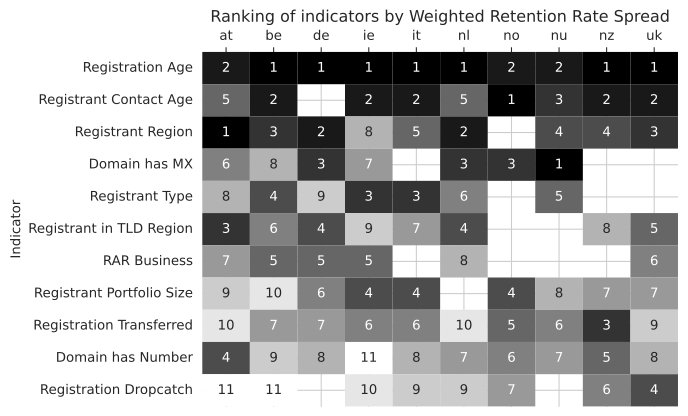
Figure 1. Factors ranked by their effect on the renewal rate. Factors with consistently high rankings across registries appear at the top, while those with lower or more registry‑specific rankings appear towards the bottom.
We’ll now dig into some of the interesting findings that stand out in those rankings.
One finding that immediately stands out is the consistent importance of registration age across all participating registries: this factor ranks highly for every registry in the analysis.
Figure 2 reveals that the youngest registrations, those registered less than one year ago, consistently have lower renewal rates than older registrations (except for .no). Across registries, this cohort has an average risk difference of –22 percentage points, indicating that first‑year domain names are substantially less likely to renew than the registry average. The opposite pattern is observed for older registrations: especially those registered for more than ten years, tend to renew more often, exhibiting positive risk differences.
However, there is notable variation between registries. At .no, first‑year registrations renew more often than average, with a positive renewal rate difference of +9 percentage points. In contrast, .nl shows a much stronger negative effect: domain names in their first year renew 44 percentage points less often than the registry average. That appears to be driven by the strategy of several larger .nl registrars, who attract customers with first‑year discounts followed by significantly higher prices in subsequent years. As a result, .nl observes many new registrations, but also many cancellations at the end of the first year.
(Click on the images to enlarge them.)
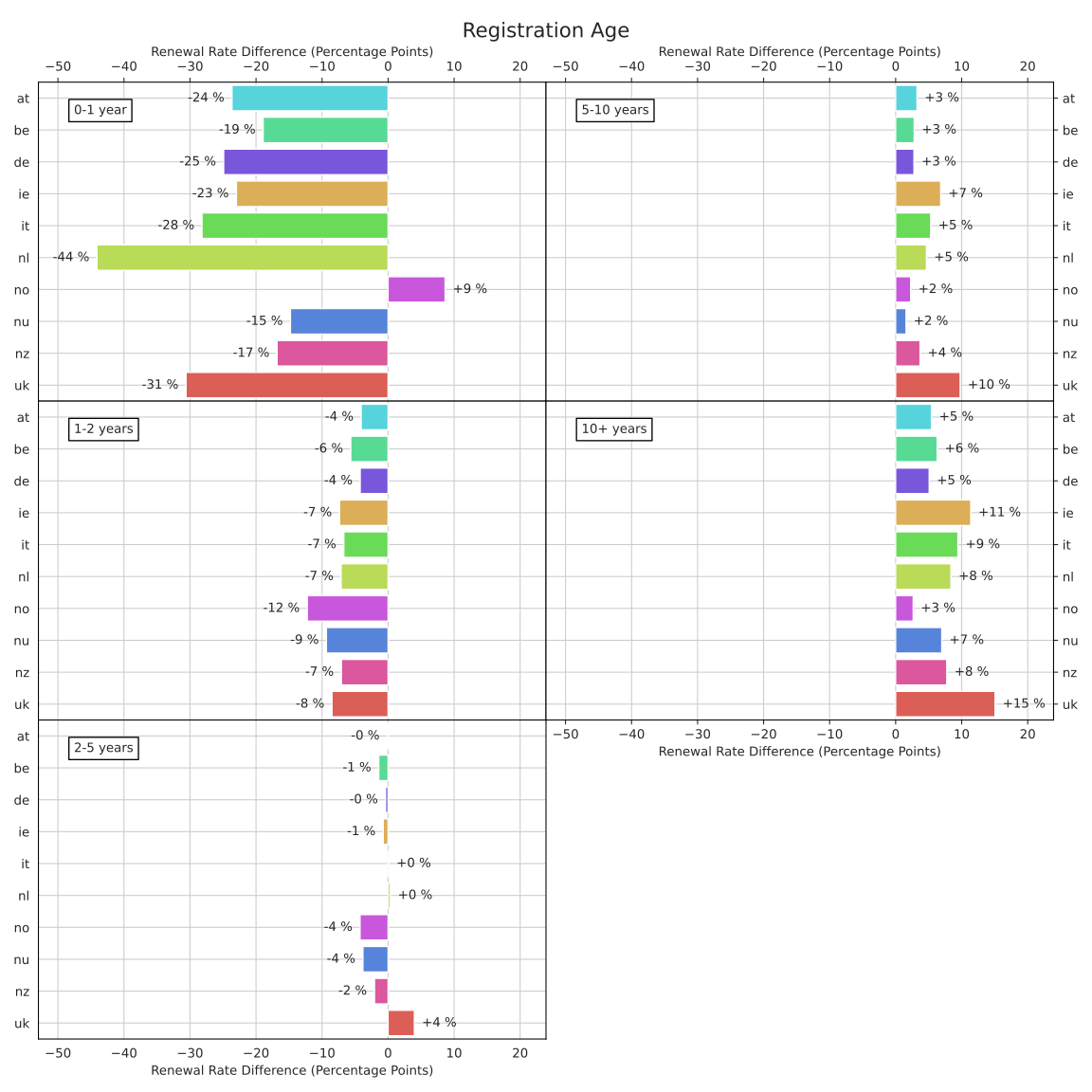
Figure 2: Risk differences for cohorts within the registration‑age factor. Each sub‑chart shows the results for a specific age cohort. The bars indicate the percentage‑point difference by which a cohort raises or lowers the registry’s average renewal rate. Unlike the ranking in Figure 1, these risk differences are not weighted by cohort size.
The second most important indicator from Figure 1 is the time elapsed since creation of the registrant contact, which is often closely related to registration age. This indicator is highly correlated with renewal, ranking within the top five for seven of the eight registries that were able to provide data. Unfortunately, this factor is unreliable for some registries (for example .at and .nl), as certain registrars create a new contact for every domain name or even for small updates to contact details, even though the underlying registrant likely remains the same.
We also observe that the registrant’s geographical region plays an important role in renewal behaviour for most ccTLD registries. The registrant region ranks in the top five for five out of eight registries that analysed this factor, while the registrant‑in‑TLD region indicator ranks in the top five for four out of seven registries.
Figure 3 shows the risk differences between registrants within and outside the ccTLD’s geographic region. On average, domain names registered by registrants located outside the TLD region renew at rates roughly 10 percentage points lower than the registry average. The underlying hypothesis is that ccTLD registries are primarily locally oriented, and that registrations from outside the core region are therefore less likely to renew. For most TLDs in the analysis, this expectation is confirmed by the data.
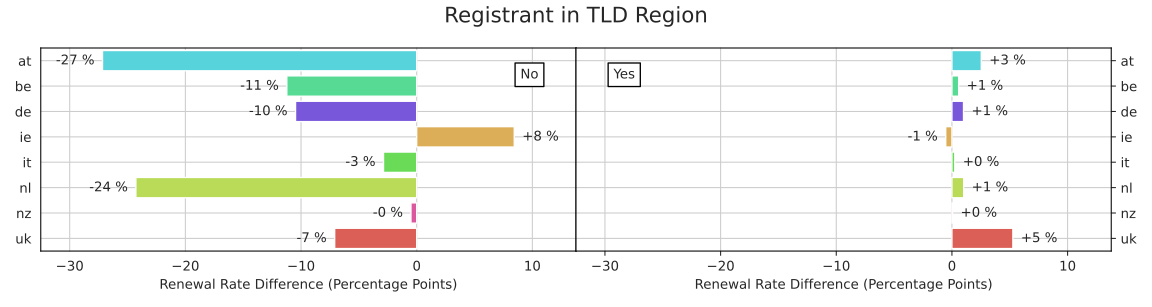
Figure 3. Risk differences for registrants in and outside the ccTLD region.
The effect is particularly pronounced for .at and .nl, where out‑of‑region registrations show the largest negative risk differences (-27 and -24 percentage points, respectively). That suggests that those ccTLDs may be especially locally focused. Figure 4 further breaks that down by registrant region and shows that registrations from Asia have clearly lower renewal rates in both .at and .nl.
An interesting exception is .ie. For that registry, registrations from outside the TLD region exhibit higher renewal rates, with a positive risk difference of approximately +8 percentage points. A possible explanation lies in .ie’s restrictive registration policy: only registrants with a connection to Ireland are eligible to register a .ie domain name. As a result, out‑of‑region registrants who meet that requirement may be particularly committed to maintaining their domain names, leading to higher renewal rates.
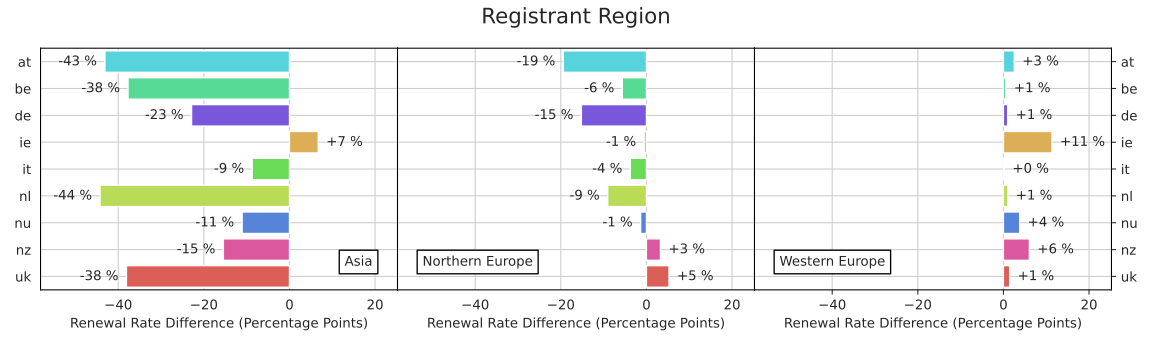
Figure 4. Risk differences for different registrant regions.
Transferring a domain name from one registrar to another is a somewhat involved process for a registrant. Going through the process might indicate that a registrant cares about the domain name and wants to keep it in the future. With the data we collected we can now test that intuition across ccTLDs. The result is shown in Figure 5.
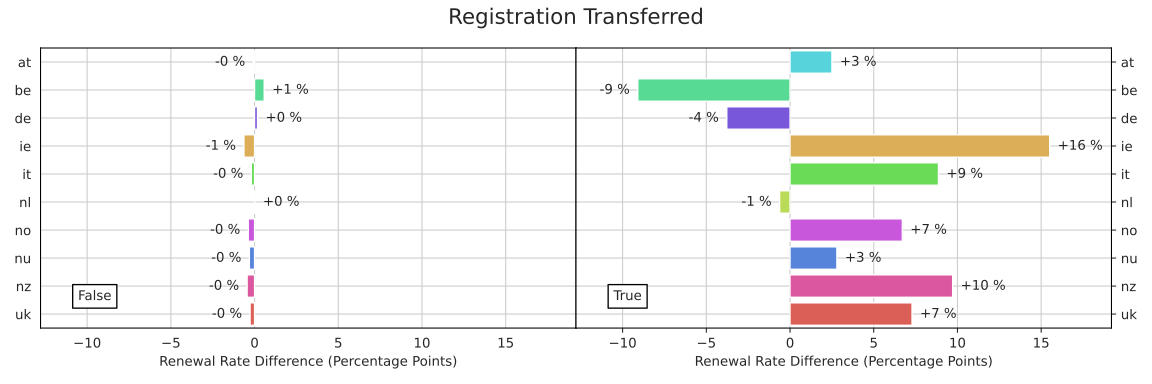
Figure 5. Risk differences for domain names that have been transferred and those that have not.
The effect we see is mixed. While it is true that a transfer coincides with a (sometimes strong) increase in renewal probability in about two-thirds of the participating TLDs, in the other TLDs the effect goes in the other direction. The reason for that difference in behaviour is unknown at this point – however, correlating registry policies and other ccTLD specific factors with the results shown provide a good starting point for further investigation and thus a better understanding of the domain name market.
The CENTR Renewal Indicators Taskforce has enabled participating registries to exchange hands‑on experience in analysing renewal behaviour and to generate shared, data‑driven insights. For example, we have confirmed that domain name age is consistently the most important indicator for domain name renewal, and that in most registries (but not all!) registrants with a local address are more likely to keep their domain name. By contrast, your mileage may vary when you use the history of a domain names’ transfers to predict whether a domain name will renew, because the importance of that factor varies significantly across registries.
Taking those and many other lessons back to our respective ccTLDs will improve the quality of renewal forecasts and may inspire new strategies to strengthen renewal performance in the future.
Looking ahead, the Taskforce has —in just a few months— developed a robust framework for applying common data analytics while keeping each ccTLD’s data under the control of the respective registry. With that foundation in place, experimenting with new approaches to renewal modelling (and other analytical topics) has become far easier. We are therefore excited about the opportunities for deeper collaboration still to come.
Do you have ideas, feedback, or see an opportunity to collaborate? Let us know via thymen.wabeke@sidn.nl, clemens.moritz@nic.at, or scastro@weare.ie.